Our Research Articles

Enforcing the Law on the Fly: The New Architecture of Digital Market Supervision in Poland
The implementation of the EU Digital Services Act (DSA) marks the moment Polish administration gains Enterprise-grade technological tools. Instead of waiting for audits, proactive organizations are moving to Shift-Left Compliance.


Software is Losing Its Head: Why Data Pipelines, Logic, and MCP are the New Moats
Software's graphical interface is no longer its competitive moat. Explore why data pipelines, operational logic, and machine-readable engines—powered by Model Context Protocol (MCP)—are becoming the true defensible advantages in the agentic AI era. Learn how organizations can transition from UI-centric design to Agent-First architecture.

The Algorithmic Arms Race: Why Even Advanced Swiss E-Commerce Is Losing to Modern Regulators
Regulatory technology has eradicated the asymmetry between digital enterprises and state supervisors. Discover why ignoring modern regulators now guarantees maximum penalties, and how to implement Proactive E-commerce Compliance through shift-left auditing and immutable audit trails.

The Scale Illusion: Why Resource Architecture is a Hidden Moat in AI Deployments
AI deployment success depends on resource architecture, not just algorithms. Learn how to optimize infrastructure for scalable inference, control costs at scale, and build resilient systems that respect the physics of compute constraints.

Algorithms vs. Algorithms: The Escalating War Between Super-Platforms and AI-Armed Regulators
E-commerce platforms face an algorithmic arms race with AI-armed regulators. Learn how to escape dark pattern vulnerabilities, optimize for agentic commerce, and build transparent infrastructure that turns compliance into competitive advantage.

Beyond Convincing Illusions: Escaping AI Pilot Purgatory via Continuous Compliance and Regression Testing
When AI outputs look perfect but lack an auditable chain of reasoning, enterprises face unacceptable risks. Discover how to move beyond plausible illusions and escape pilot purgatory through automated regression testing, traceability, and a Shared Compliance Model.

The Prompt Engineering Fallacy: Why Enterprise AI is a Data Pipeline Problem
Enterprise AI's competitive advantage lies not in prompt engineering, but in data pipeline excellence. Learn how the Firstscore AI Platform uses multi-agent orchestration, context compilation, and specialized language models to deliver enterprise-grade AI infrastructure that outperforms monolithic approaches—transforming compliance, market supervision, and operational decision-making at scale.

How Agentic AI is Rewriting Market Supervision and E-commerce Compliance
Agentic AI is closing the technological gap between regulators and e-commerce platforms. Discover how the Firstscore AI Platform deployed at UOKiK uses multi-agent systems, autonomous crawling, and explainable AI to detect dark patterns at scale—and how this shift is rewriting market supervision and compliance across Europe.

The Liability of Opaque Algorithms: Engineering Explainability and Auditability for Regulated Enterprise AI
Explore how Firstscore AI Platform achieves true explainability and auditability through deterministic orchestration, mechanical explainability reports, and immutable blockchain audit trails. Learn how enterprises can deploy AI safely in regulated environments while ensuring compliance with the EU AI Act, maintaining data sovereignty, and eliminating vendor lock-in.

Architecting Enterprise AI: The Divergent Physics of Real-Time and Batch Processing
Real-time and batch processing demand fundamentally different architectural approaches. Learn how Firstscore AI Platform decouples online interactions—optimized for low latency and high concurrency—from offline workflows designed for precision, compliance, and state synchronization. Essential reading for enterprises deploying AI in critical infrastructure.
Platform Update: Enterprise-Grade API, Monitoring, and Security
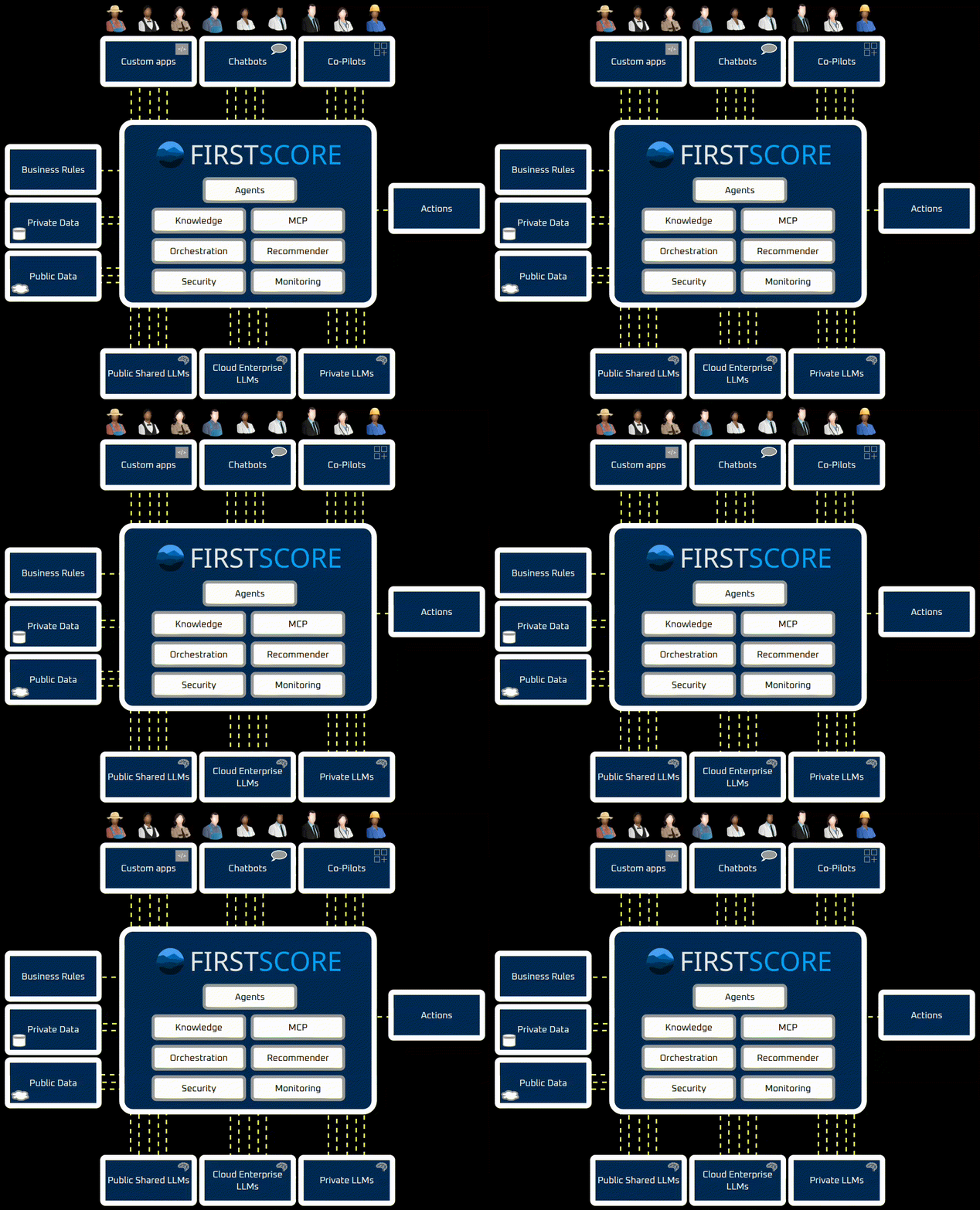
Our latest update introduces powerful tools for developers and administrators. We're rolling out a fully documented REST API, native integration with Zabbix and SIEM monitoring, and Single Sign-On (SSO) with Microsoft Entra ID. The Firstscore platform is now more open, observable, and secure than ever.

Integrating Multi-Agent Systems with Enterprise Data Layers
To achieve operational value, enterprises must ground their AI infrastructure in proprietary data. We explore how integrating a network of specialized agents with robust data layers drives deterministic results.
Memory Management in Intelligent Solutions: Key Types of Agent Memory
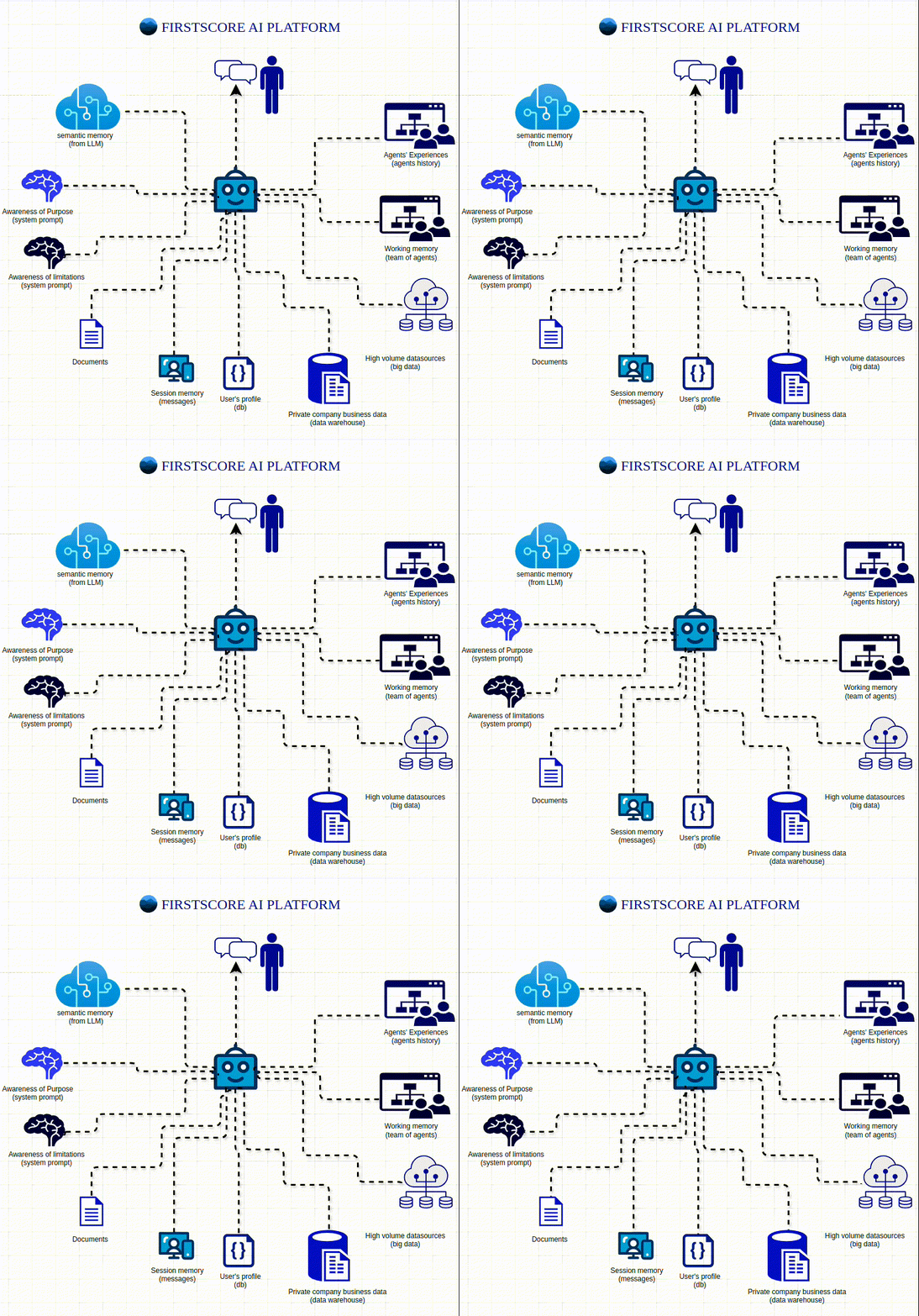
Memory management is a critical challenge in creating intelligent solutions. Discover the nine types of Agent memory used in our platform.

Deterministic Orchestration: Practical Implementations of Multi-Agent Systems
Our platform relies on deterministic, agent-based orchestration, enabling the secure deployment of complex workflows. We detail the structural principles governing our multi-agent architecture.

The Standardization of AI Agents: Frameworks and Interoperability
The true challenge for the enterprise is no longer acquiring models, but orchestrating them. We examine the new frameworks driving agent interoperability and how deterministic orchestration is becoming the industry standard.

Engineering Traceability: Real-Time Transparency of AI Logic
We are introducing a critical capability for regulated environments: complete real-time transparency of AI logic. Every action, tool call, and data retrieval step performed by the system is now fully visible and auditable.

How We Effectively Reduce AI Hallucinations in Firstscore Platform
Discover the simple and advanced methods we use to effectively reduce AI hallucinations in the Firstscore platform, leading to more reliable and accurate results.

Automated Regression Testing: Ensuring AI Compliance at Scale
Manual testing of non-deterministic AI systems is inadequate for regulated environments. We detail the deployment of an automated, multi-agent validation swarm to guarantee operational reliability.

Adversarial Agent Orchestration: GPT-4 and DeepSeek v3
We deployed two distinct foundational models in an adversarial configuration to evaluate complex policies. This interaction highlights the critical importance of model agnosticism in enterprise infrastructure.

Three Key Features of Our Platform – Contact Us for Pilot Implementations
Discover the key features of our platform that help extract knowledge from private documents, support a wide range of LLM providers, and offer contextual decision-making assistance. Contact us for pilot implementations.

A Month Ago, I Challenged LLM Models – They Had to Predict Whether a Fort Knox Audit Would Happen
A challenge was issued to LLM models to predict a Fort Knox audit, and while the models showed conservative results, some did highlight potential market movements. The experiment raises important questions about the predictive power of AI.

Operational Leverage: The Advantage of Context-Aware AI Pipelines
Generalized AI models lack operational memory and organizational context. True operational leverage is achieved through stateful, context-aware RAG pipelines that integrate directly with proprietary data.

Architectural Foundations: Separating the Cognitive Engine from the Interface
Sustainable enterprise AI requires a strict separation between the core orchestration engine and the client-facing presentation layer. We examine the 80/20 delivery model.

The Liability of 'Shadow AI': Why Rapid Prototyping Fails the Enterprise
The proliferation of AI-generated applications built in minutes introduces severe technical debt and security risks. Enterprise AI requires architectural rigor, product-driven governance, and deep system integration.

AI Does Not Know the Future.
Despite the growing enthusiasm around AI, it is important to understand its limitations. Artificial intelligence does not know the future, does not understand meanings, and does not create inspiration. AGI remains more of a myth than a real goal.

Classic RAG Was Definitely Not Enough
After encountering many obstacles and failures while building a textbook architecture, we've developed something more advanced. Soon, we'll have our internal perplexity engine working on private data and granting superpowers to users.

RAG vs finetunning
The race for industry-specific AI models is accelerating, with companies choosing between fine-tuning generic models for precision and consistency or adopting RAG for flexibility, up-to-date information, and cost efficiency, each offering distinct advantages and challenges.

Data in AI
The key to outperforming universal AI models lies in acquiring exclusive, high-quality industry-specific data, as real data—rather than generic LLM outputs—drives competitive advantage in AI development.

Stateless AI
AI-powered services rely on predictive algorithms to generate responses, but their success hinges on effective context retention, achieved through scalable data modeling and dual NoSQL databases.


The Strategic Economics of Sovereign AI Infrastructure
As base language models rapidly commoditize, long-term enterprise value is built exclusively through sovereign data integration, robust deterministic architecture, and zero-trust infrastructure.

Causal Inference: Beyond Basic Data Analytics in Enterprise AI
Data volume alone cannot solve complex operational problems. In regulated environments, AI systems must move beyond correlations to causal reasoning and explainability to meet compliance standards.

Can AI Truly Understand Your Organization?
Effective AI relies on precise, context-aware search to leverage internal knowledge, ensuring accurate results in recommendation systems and RAG models by preparing, enriching, and optimizing domain-specific data.

How to Build a Recommender System
AI projects can be exciting yet challenging, requiring clear goals, quality data, and flexibility to navigate hurdles like the "valley of death" and technical debt, ultimately leading to valuable, scalable solutions.

Multi-Agent Orchestration: Engineering Continuous Validation
Discover how our architecture integrates specialized language models—including LLaMA, Gemma, and Bielik—into a deterministic validation pipeline, ensuring continuous improvement and robust compliance.

AI Wargames
We simplify AI implementation by automating hyperparameter tuning, using AI to validate models, and continuously refining algorithms, ensuring high-quality, cost-effective solutions for any business.

Processing Complex Financial Datasets: Architectural Lessons
Analyzing daily transactions from hedge funds and insiders managing $50 trillion requires scalable infrastructure. We explore the data architecture and serverless pipelines powering high-frequency data models.

Avoiding AI Hallucinations: Best Practices
AI solutions require careful planning, solid data, and effective constraints to prevent hallucinations and ensure accurate results, especially when extracting knowledge from unstructured or private data.

The Role of Conversation Flows
The AI market is rapidly growing, with chatbot automation expected to reach billion-dollar valuations by 2030, while startups face challenges from technology providers replicating their innovations.

New Era of Personalization
AI-driven hyper-personalization is revolutionizing user experiences by continuously adapting to individual preferences and behaviors, making interactions more tailored and valuable than ever before.

Infrastructure for AI
When implementing AI, companies must carefully choose between cloud, hybrid, or on-premise infrastructure to align with their goals, ensuring the right balance of flexibility, security, and scalability.

Optimizing Non-English LLMs
To effectively use non-English LLMs like Bielik for Polish, combining it with larger models for advanced logic and reasoning ensures both linguistic accuracy and task performance.

High-Volume Batch Processing: Automating Data Extraction at Scale
Processing thousands of documents requires robust data pipelines. Learn how Firstscore utilizes asynchronous batch engines and LLMs to automate complex data extraction at an enterprise scale.

Strategy Leading to Evolution
Success in startups requires embracing evolution, discarding failed attempts, and continuously adapting strategies based on customer needs and feedback.

The Challenges for Companies
In 2024, AI is set to transform business, with companies focusing on implementation, customization, and security while leveraging open-source models and emerging applications to unlock data-driven insights.

From Experimental APIs to Sovereign Enterprise Architecture
Early access to generalized LLM APIs revealed a fundamental truth: relying on third-party endpoints is insufficient for enterprise needs. We explain the shift toward sovereign, deterministic AI architectures.